Tuesday, May 11, 2010

Aliens & Animals, the Other to rational man

Recently the cyborg Stephen Hawking has warned that aliens coming to earth would not be coming in peace.
“We only have to look at ourselves to see how intelligent life might develop into something we wouldn’t want to meet. I imagine they might exist in massive ships, having used up all the resources from their home planet. Such advanced aliens would perhaps become nomads, looking to conquer and colonise whatever planets they can reach. . . . If aliens ever visit us, I think the outcome would be much as when Christopher Columbus first landed in America, which didn’t turn out very well for the Native Americans.” Think here of T-Bone Burnett’s “Humans from the Earth.”

And yet, aliens are a necessary supplement which help us think what it means to be human. David Clark builds out this point with his stellar essay “Kant’s Aliens.” As he explains, in the final pages of Anthropology from a Pragmatic Point of View Kant considers that the only way to understand a species is by comparison to others. In order to know man as a terrestrial rational animal, he should be compared to a non-terrestrial rational creature:
The highest concept of species may be that of a terrestrial rational being, but we will not be able to describe its characteristics because we do not know of a nonterrestrial rational being which would enable us to refer to its properties and consequently classify that terrestrial being as rational. It seems, therefore, that the problem of giving an account of the character of the human species is quite insoluble, because the problem could only be solved by comparing two species of rational beings on the basis of experience, but experience has not offered us a comparison between two species of rational beings”

As Clark mentions, Kant’s “off-world interest go back to Kant’s first major work, the cosmological treatise entitled Universal Natural History and Theory of the Heavens [1755]” (see the “Appendix” on “the inhabitants of the stars”).

Clark nicely connect this to “This is an almost Nietzschean question—one asked, we might recall, by
Friedrich in the essay ‘On Truth and Lying in a Non-Moral Sense’ that spookily begins by imagining what “man” might look like through the pitiless eyes of an alien zoologist.” Indeed, this opening passage from Nietzsche has been an inspiration for the revolution!

Now dear reader, if you have wandered into reading this far, consider that each animal is in its own umwelt, its own world. Indeed, animals are aliens to us—as is our own animality. We can measure humans and “thinking otherwise” by weighing ourselves against the scale of these creatures. Kant is concerned with rational beings and measuring ourselves against a “nonterrestrial rational being”; yet why privilege reason and who is to say that alien reason would be anything like our own? What is this alien "to come" and land among us? Are they already here? (and yes, see my Lovecraft post.)

Monday, April 19, 2010

Octopus films his stealth underworld

Great footage of an octopus taking a camera from a diver and filming with it so the viewer gets a bit of octopus umwelt. He next goes for the diver's spear gun. Clearly the cephlopod wants to televise the animal revolution.

For more on the revolutionary behavior of octopus, see my entry on Octo-armor and another on an octopus flooding an aquarium floor.

Perhaps the revolution will be televised?

Saturday, April 10, 2010

The Event & The Differend


The animal revolution is an event. To understand what this means, consider Bill Readings on Lyotard’s concept “the event." Lyotard's event “disrupts any pre-existing referential frame within which it might be represented or understood. The eventhood of the event is the radical singularity of happening, the ‘it happens’ as distinct from the sense of ‘what is happening’” (Introducing Lyotard xxxi). He goes on to say “The event is the occurrence after which nothing will ever be the same again. The event, that is, happens in excess of the referential frame within which it might be understood, disrupting or displacing that frame” (57).

Of course, the concept needs to be developed for the revolution. To do so, (note to future self), look at Lyotard’s The Differend (p 79-80 & X). This event and its wake: “It is not in their power to pass over in silence what they cannot speak about. Insofar as it is unable to be phrased in the common idioms, it is already phrased, as a feeling. The vigil for an occurrence, the anxiety and the joy of an unknown idiom, has begun” (80).

Lyotard’s “differend” takes into a logic of the supplement which exceeds and undoes the laws of the current regime. How is one to express the error of anthropocentrism within a humanist world? One would need a new world and new language: “To give the differend its due is to institute new addressees, new addressors, new significations, and new referents in order for the wrong to find an expression and for the plaintiff to cease being a victim. . . . The differend is the unstable state and instant of language wherein something which must be able to be put into phrases cannot yet be.” If, following Hiedegger, language is the house where humans dwell, then a new language calls for new tenants. The event as “unstable state” wrecks the house of language and simultaneously constructs something new, a new house and new residents, “new addressees, new addressors, new significations, and new referents.”

Sunday, March 28, 2010

shaman & salmon


As reported in the NY Times: "more than two dozen Native Americans embarked from here [San Francisco] on a spiritual mission to New Zealand, where they will ask their fish to come home to California."
"The fish in question is the Chinook salmon, native to the Pacific but lately in short supply in the rivers of Northern California, home to the Winnemem Wintu — a tiny, federally unrecognized and poor tribe"

The whole story involves technology, politics, polis, and animality. The Chinook were important for the spiritual and material prosperity of the tribe. Salmon thrived until the Shasta Dam was built in the 1940s. After that, the fish population steadily declined. As techne and fortunes would have it: "the United States government once bred millions of Chinook eggs from the McCloud River and shipped them around the world in hopes of creating new fisheries, including a batch that went to the South Island of New Zealand, where the fish thrived."

The tribe apologized to the salmon for allowing the dam to be build and not doing more to preserve the fish dwelling. The called to the salmon to come home. And so, we wait...

Drunk Pennsylvania man tried to revive dead opossum

Okay, this is the title from the Associated Press for the Times Tribune article. The police, the law, the State calls to him, hails. But this fellow--Donald Wolfe--is out of it, out of bounds. The police, the law, the State see a drunken man trying to revive a dead opossum; they see him gesticulating over the road kill. But for another angel, the animal revolutionary knows what this is about: it is a Dionysian rite in which the mangled body of the god/animal is brought into contact with the human.

"The trooper says one person saw Wolfe kneeling before the animal and gesturing as though he were conducting a seance, while another saw the mouth-to-mouth attempt. Levier says Wolfe was 'extremely intoxicated" and "did have his mouth in the area of the animal's mouth, I guess.'" Yes, a seance but who is calling to whom? Intoxicated Wolfe refuses the proper name, the social name, and reverts to its material animality... in animal state he is called by the non-State player, the animal before him, he follows after. Where will this lead? Can the opossum's spirit be translated? The police fail to investigate the opossum's death and do not ask it any questions. Their omission is itself a tale.

Thursday, March 25, 2010

Return of the Urban Animal


Thanks to
Bryndis Snaebjornsdottir for noticing this. In
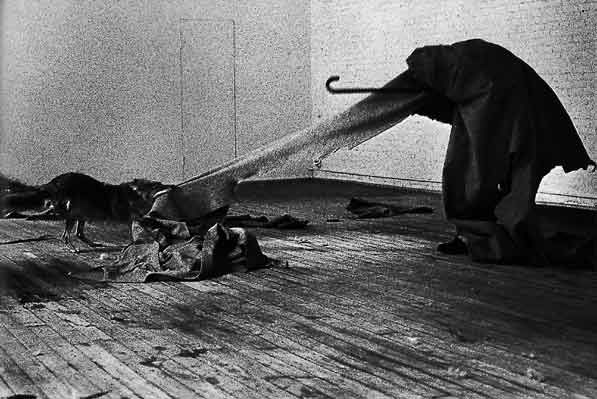
I Like America and America Likes Me, for three days Joseph Beuys lived in a gallery space with a coyote in the Rene Block Gallery at 409 West Broadway in New York. The piece was a gesture of pidgin language between world and across politics (German, American, and animal).
You could say that a reckoning has to be made with the coyote, and only then can this trauma be lifted.
A reckoning, indeed. Now, the coyote is back in New York. Is this an offspring from the coyote Beuys met? Is the critter looking for Beuys or his artistic descendants? Does he want a rematch? There is more reckoning to be done--more thinking, more reconciliation, more aktion in an Event "to-come."

Thanks to Angela Ellsworth for calling my attention to this--humans are walking the tracks of the coyote in a meandering becoming-other creating political alternative cartographies. 

Friday, March 5, 2010

Landmine Detecting Rats!


The Revolution knows how to burrow. From the organization APOPO come rats trained to find and dig mines. These HeroRats are trained to be sent into fields and detect and dig for mines. Other specialty rats sniff out tuberculosis. "APOPO’s mission is to train and disseminate sniffer rats to save human lives- by detecting landmines and disease."

My dear reader: rats + mines. Is this not the sign of a revolution. Once they nourish active rebellion, where can a human hide that a rat will not sniff out, burrow, bury. Think Willard (either the 1972 version or the 2007 version). And yes, think swarm as in Ben (1972).
My thanks to Jane Prophet for pointing out this moment of revolution.