Showing posts with label theory. Show all posts

Saturday, August 27, 2011

Yvonne the cow as difference


How can we think difference in itself? It is a question posed by Deleuze in Difference and Repetition. Examples of D's thinking are hard to come by since the question bears upon the unrepresentable. Animality offers a mode of engaging difference in itself. Cows are domesticated beasts but for Yvonne the cow, domestication is merely a camouflage. She has not only taken herself out to pasture, she kept running and is in full on wilderness. Some in Germany are hunting to kill her. The State says she posses a threat since her corporality, her animality that was used for commercial gain in milking, has turned into a possible weapon should she step onto a road and get hit by a car. Others, animal welfare folk, want to bring her into the fold and give her a safe home. But Yvonne is having none of this dialectics. She has receded into the wildnerness and humans can't find her. Recall Heraclitus: "Nature loves to hide." But really, must we seek it? Can it not be into and of itself. Allowing Yvonne to be is a recognition of a difference in itself, one that cannot be domesticated but roams of its own accord.

Wednesday, July 6, 2011

Animal Portraiture


Noted photographer David Salter visited a national park in North Sulawesi, Indonesia in order to photograph the endangered Celebes crested macaque monkeys. The animals seem friendly enough. They are not afraid of humans and seemed wonderfully curious about Salter and the human technologies he lugged into the forest. The photographer put down his camera momentarily only to have a female macaque break from the group and take the camera. The machine was passed among the animals. A dexterous beast became fascinated with his reflection in the camera lens and somehow managed to take a snapshot self-portrait. The sound of the camera click scared the rest of the macaques but curiosity overcame caution as the animals took up the camera again and snapped a few more pictures. Salter explains “At first there was a lot of grimacing with their teeth showing because it was probably the first time they had ever seen a reflection. . . . They were quite mischievous jumping all over my equipment, and it looked like they were already posing for the camera when one hit the button.” Ultimately, the animals snapped over a hundred pictures before the photographer got his camera back. Salter seemed pleased with the results: “I wish I could have stayed longer as he probably would have taken a full family album.”


Portraiture is a rather unique and uniquely human art. From portrait paintings to photography, the portrait tells a story about the outward social status of the human represented (often surrounded by possessions) or the inner psychological state of the subject (think brooding author photos on book covers). In short, portraiture is about having standing—as a social being amid others or about the privileged interiority of the human subject. In other words, you are some one and you think about things.

Occasionally we find pet portraiture which reflects not simply on the animal him/herself but on the human owner and the social standing of the animal for the individual and the culture.

Portraiture reinforces what Emmanuel Levinas calls “face.” Having face means you are an ethical being who recognizes others and your ethical and social duty toward others. When portraiture captures faces, they are also depicting face. The image acknowledges social and moral standing of the human being depicted. So powerful is the concept of portraiture that James Mollison took brilliant, large, crisp photos of great apes as a gesture of cross-species social and moral standing (see James and Other Apes, 2005). The apes are still waiting on their social standing (perhaps via the Great Ape Project with its curious acronym GAP).


Now enter the Celebes crested macaques who take matters in their own hands. Since humans won’t grant face nor portraiture to animals, they do so for themselves. Levinas never granted that animals had face but the macaques in their portraits grimace as if to say: “I don’t need you to grant that I see you as a being toward which I should be social. Here human, here is a picture of me and by me. Here are others I’ve taken of my group. Am I social? Look around. Am I moral? Ask your neo-Darwinian scientists and they will tell you what I already know but you refuse to believe: I am and I be through my sociability. Survival of the fittest is survival of fitting into an ecology and a society here in the wilds.” And so it is that the macaques grasp technology to reconfigure portraiture.


They are not the only beings to run with a camera. See the Umwelt of the camcorder octopus and the flight of a camcorder stealing seagull. See too Sir Edwin Landseer parodying our concept of portraits and sociability in The Monkey Who Had Seen the World (1827).

Wednesday, January 12, 2011

What is the voice of the inhuman?


I will begin with the punch line and lure: have a look at
Scrambles of the Earth. The premise of the site begins with a cd of music sent in the 1977 Voyager spacecraft into outer space. The site claims the music was found by aliens who remixed it to their liking in order to make the sound more hip: “Aliens want state-of-art mega-hip scene. But music on Voyager record is hundreds of years old! No synthesizer, no drum machine, no dance remix! No wondering that, in ten year, not a one alien has called! Aliens hear old tunage, [then] puke out all kidneys from ear-pain. [They] say: 'Gaia beings are coma-toast lamo Gilligans.'” The samples on the website are haunting and aptly described by Rich Doyle’s concept of the alien: “the very essence of the alien presence … [is] its characteristic ability to proliferate and mutate, disturbing the various taxonomical categories that we bring to bear on ‘them.’” So, from aliens to animals… where do we go from here?


Wittgenstein's lion: “If a lion could talk, we could not understand him”(Wolfe Zoontologies 1). The lion problem is an issue of speaking and sound which is related to voice but different. In this problem the concern is social community, the discourse community in which language is fashioned to human (or nonhuman) experience of being-in-the-world or as Wittgenstein says "To imagine a language is to imagine a form of life." A lion’s sense of being is different and its use of language would be different—even, as Wittgenstein says—unintelligible.


Rather than speech and language I'm interested in voice (which I’ll enter as a new keyword in this animal revolution lexicon). Voice precedes speech and enables it but not just humans have voice: “Yes, there’s no speech without voice, but there is such a thing as voice without speech. And not just for animals, but for us as well" (Vox Clamans in Deserto 38). Nancy characterizes voice as singular difference--each voice, he claims, is more unique than a fingerprint. So, it is not a common ground since voice is not a ground but a plurality. It is a sort of shared difference.


Can we use this capacity to address the other in an address, admittedly, that would be outside of discourse community and outside of language?! It would be an odd address, indeed, and Nancy hints at it throughout his essay and particularly at the end where voices resonate and call out to the other from one other to an/other. Voice cannot hear but can voice; it can throw itself and articulates what it means to be bodily thrown into the world, a being who is situated in a world (more on this in a moment). Hearing voice transports the listener, possesses and intoxicates to listener who may well give voice in response—the Dionysian Nietzsche (see Birth of Tragedy) and even Nancy assert.


This is where we get to aliens, so hang on. First it is useful to understand Nancy's claim that "Every voice cries out in the desert. . . . the desert of deserted existence, prey both to lack and to absence”(41). The voice is corporeal but not by way of taking in (food, air) nor by expelling (vomit and shit) but as an opening and opening up, opening the body in and unto the world. By way of example, he quotes a poetic passage from Julia Kristeva about a baby crying which ends with "The voice springs from this rejection of air and nutritive or excremental matter; so as to be vocal, the first sonorous emissions not only have their origins in the glottis but are the audible mark of a complex phenomenon of muscular and rhythmic contractions that is a rejection implicating the whole body.”


Secondly, animals and aliens have bodies which give voice. Each voice is different—its own patters. Yet in each singular instance, the voices cry out, the bodies open themselves, throw the voice into the air and within hearing of the other:"The voice cries out in the desert because voice itself is the desert that unfolds at the very heart of the body, beyond words." It is rather important that this is an opening and unfolding beyond words since (recalling Wittgenstein) if the alien and animal speak, we could not understand them. But outside of understanding and beyond speech and words, what we can hear and become enthralled by is the voice of the other. Listen those who have ears to hear—as the biblical passage goes. And transported, carried (dare I say abducted? Or is this another matter?) and recognizing this opening, we give voice in return.


Nancy is not a lone voice in the desert crying out. He takes up a particular line of thinking from Kant, Bentham, and Levinas on the look and the cry of animals.


Kant: "Just as Descartes had the paradoxical opinion of animal-machines, so must I likewise say of humans and of myself as well, only to a greater degree: if that one howls like a machine, then I speak like one. Because of the similarity between our external behaviour and that of the animal, I judge that the inner condition of the other involves thinking and sensing like mine, for my behaviour is regarded by it just as it is regarded by me.I therefore have just as much cause not to take him as a machine as to take myself as one.” [p. 3 of Naragon, Steve.“Kant on Descartes and the Brutes” in Kant-Studien, 81: 1-23 (1990)]


Bentham: "The question is not, Can they reason? nor, Can they talk? but, Can they suffer?” Bentham, Jeremy. Introduction to the Principles of Morals and Legislation, second edition, 1823, chapter 17, footnote.


Levinas tells the story of the dog named Bobby who greeted the prisoners at the Nazi concentration camp and treated them with respect and dignity. The "mere” dog’s treatment of these humans stood in stark contrast to the treatment by other humans. And so the question asked is can animals have what Levinas calls "face” by which he means recognition within the (human) community as a moral citizen and toward which one has moral obligations. While Levinas disconcertingly says Bobby and animals should not be given this recognition, other philosophers have taken up Bobby's cause and argued otherwise. The look and regard of the animal—and I would add voice of Bobby—calls for recognition by us. (Here David Clark, "Towards a Prehistory of the Postanimal: Kant, Levinas, and the Regard of Brutes.” Unpublished manuscript. Critchley on Levinas is rather good: see Infinitely Demanding)


What voice offers us then is an ungrounded ground—a multitude of singularities—which calls to the other. Voice as the opening in the self is, as Nancy suggests, the space where the self is beside itself, leaves itself and in hospitality offers its openness to the world. We sense this vibration (here the play of sensation and sensibility works well) and in the hospitality of sense, sense surrenders itself to the foreign.

Wednesday, October 6, 2010

How to read signs of the animal revolution

“Of course, in order to practice this style of reading as art, one thing is above all essential, something that today has been thoroughly forgotten—and so it will require still more time before my writings are ‘readable’—something for which one almost needs to be a cow, at any rate not a ‘modern man’—rumination.”
--Fredrick Nietzsche, Genealogy of Morals

Friday, September 17, 2010

Vox Clamans in Deserto

Complete with animal voices--dogs barking, a donkey wandering across stage, all in Jean-Luc Nancy's essay/play meditation on body, voice, and speech.
"Voice has nothing to do with speech. Yes, there's no speech without voice, but there is such a thing as voice without speech. And not just for animals, but for us as well. There's voice before speech. Because I know you, I recognized your voice as you were coming toward me, long before I could make out what you were actually saying." (from Vox Clamans in Deserto by Nancy)

This links with David Clark's work on Derrida & Levinas where Clark claims the animal give voice (to pain) and so are moral subjects deserving recognition. What do aliens and animals say? How could we understand this foreign language? Bodies--the necessary component of voice--are the "exploit" (as Eugene Thacker would say). They are the way out of the hermeneutic circle of cultural meaning; they level us, take us away from speech (words, language), into a body (see Nancy's The Birth to Presence) that takes us elsewhere ... toward an animal revolution.

So, voice is a split decision, it splits between cultural speech) which does not need voice and the cultural obligation of moral rights to those who have a voice, those who can be heard.

Tuesday, September 14, 2010

Eugene Thacker's After Life


Thacker's book is out with Chicago UP in November 2010. Here is a bit from the introduction to entice those interested in the non-human world.

Tuesday, May 11, 2010

Aliens & Animals, the Other to rational man

Recently the cyborg Stephen Hawking has warned that aliens coming to earth would not be coming in peace.
“We only have to look at ourselves to see how intelligent life might develop into something we wouldn’t want to meet. I imagine they might exist in massive ships, having used up all the resources from their home planet. Such advanced aliens would perhaps become nomads, looking to conquer and colonise whatever planets they can reach. . . . If aliens ever visit us, I think the outcome would be much as when Christopher Columbus first landed in America, which didn’t turn out very well for the Native Americans.” Think here of T-Bone Burnett’s “Humans from the Earth.”

And yet, aliens are a necessary supplement which help us think what it means to be human. David Clark builds out this point with his stellar essay “Kant’s Aliens.” As he explains, in the final pages of Anthropology from a Pragmatic Point of View Kant considers that the only way to understand a species is by comparison to others. In order to know man as a terrestrial rational animal, he should be compared to a non-terrestrial rational creature:
The highest concept of species may be that of a terrestrial rational being, but we will not be able to describe its characteristics because we do not know of a nonterrestrial rational being which would enable us to refer to its properties and consequently classify that terrestrial being as rational. It seems, therefore, that the problem of giving an account of the character of the human species is quite insoluble, because the problem could only be solved by comparing two species of rational beings on the basis of experience, but experience has not offered us a comparison between two species of rational beings”

As Clark mentions, Kant’s “off-world interest go back to Kant’s first major work, the cosmological treatise entitled Universal Natural History and Theory of the Heavens [1755]” (see the “Appendix” on “the inhabitants of the stars”).

Clark nicely connect this to “This is an almost Nietzschean question—one asked, we might recall, by
Friedrich in the essay ‘On Truth and Lying in a Non-Moral Sense’ that spookily begins by imagining what “man” might look like through the pitiless eyes of an alien zoologist.” Indeed, this opening passage from Nietzsche has been an inspiration for the revolution!

Now dear reader, if you have wandered into reading this far, consider that each animal is in its own umwelt, its own world. Indeed, animals are aliens to us—as is our own animality. We can measure humans and “thinking otherwise” by weighing ourselves against the scale of these creatures. Kant is concerned with rational beings and measuring ourselves against a “nonterrestrial rational being”; yet why privilege reason and who is to say that alien reason would be anything like our own? What is this alien "to come" and land among us? Are they already here? (and yes, see my Lovecraft post.)

Saturday, April 10, 2010

The Event & The Differend


The animal revolution is an event. To understand what this means, consider Bill Readings on Lyotard’s concept “the event." Lyotard's event “disrupts any pre-existing referential frame within which it might be represented or understood. The eventhood of the event is the radical singularity of happening, the ‘it happens’ as distinct from the sense of ‘what is happening’” (Introducing Lyotard xxxi). He goes on to say “The event is the occurrence after which nothing will ever be the same again. The event, that is, happens in excess of the referential frame within which it might be understood, disrupting or displacing that frame” (57).

Of course, the concept needs to be developed for the revolution. To do so, (note to future self), look at Lyotard’s The Differend (p 79-80 & X). This event and its wake: “It is not in their power to pass over in silence what they cannot speak about. Insofar as it is unable to be phrased in the common idioms, it is already phrased, as a feeling. The vigil for an occurrence, the anxiety and the joy of an unknown idiom, has begun” (80).

Lyotard’s “differend” takes into a logic of the supplement which exceeds and undoes the laws of the current regime. How is one to express the error of anthropocentrism within a humanist world? One would need a new world and new language: “To give the differend its due is to institute new addressees, new addressors, new significations, and new referents in order for the wrong to find an expression and for the plaintiff to cease being a victim. . . . The differend is the unstable state and instant of language wherein something which must be able to be put into phrases cannot yet be.” If, following Hiedegger, language is the house where humans dwell, then a new language calls for new tenants. The event as “unstable state” wrecks the house of language and simultaneously constructs something new, a new house and new residents, “new addressees, new addressors, new significations, and new referents.”

Thursday, March 25, 2010

Return of the Urban Animal


Thanks to
Bryndis Snaebjornsdottir for noticing this. In
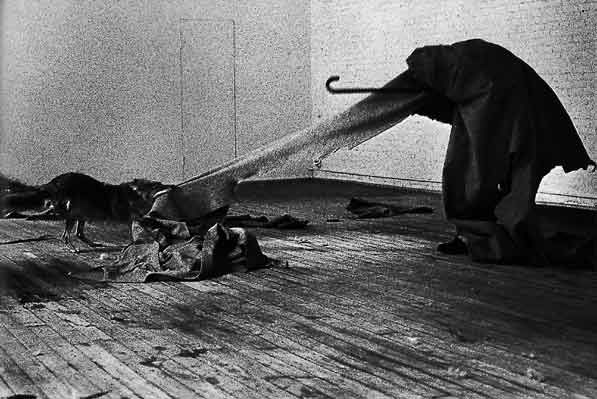
I Like America and America Likes Me, for three days Joseph Beuys lived in a gallery space with a coyote in the Rene Block Gallery at 409 West Broadway in New York. The piece was a gesture of pidgin language between world and across politics (German, American, and animal).
You could say that a reckoning has to be made with the coyote, and only then can this trauma be lifted.
A reckoning, indeed. Now, the coyote is back in New York. Is this an offspring from the coyote Beuys met? Is the critter looking for Beuys or his artistic descendants? Does he want a rematch? There is more reckoning to be done--more thinking, more reconciliation, more aktion in an Event "to-come."

Thanks to Angela Ellsworth for calling my attention to this--humans are walking the tracks of the coyote in a meandering becoming-other creating political alternative cartographies. 

Wednesday, December 16, 2009

RIP Lester Shubin


Dear Lester, your work here on earth is done. You've supplied the animals with functional gear for the revolution. Indeed, animals haunt the techne produced by Shubin and they will put it to good ends.

Shubin is responsible for the invention of the Kevlar bullet-proof vest. He had heard about the substance developed by DuPont, a material which is light as nylon but tough as steel. He began testing it as an armor. He first tried it on a gel then on goats. . . . ah, the unfortunate goats deformed and lost in this... they will haunt the materials for the revolutionary future(s).

Shubin is also responsible for bomb-sniffing dogs. Yes, we've militarized the beasts. (Think the comic We3).

Addendum: the military practices its field war zone medical "tissue training" on goats. Video footage shows "shears and scalpels being used to inflict wounds and amputate the legs of anesthetized goats so trainees can practice war zone emergency techniques"

Friday, July 10, 2009

Bat Tower and Architectures to come


Nagel posses the question "What is it like to be a bat?" Heidegger claims that humans become human through their building-dwelling-thinking triad. Now, what happens when one builds for another species? Do we become more human or more animal?

These questions are posed by the monolithic and haunting Bat Tower in Sugarloaf Key (mile marker 17 in the keys). The tower was built in 1929 with the notion of using bats to eat the misquotes and other pests and so combat malaria in the area. The tower was built by Richter Clyde Perky, a fish lodge owner, according to designs from Charles Campbell, a pioneer of bat studies. Bats were bought in from Cuba and Texas to inhabit the tower but eventually flew away and disappeared. No one knows what happened to the bats and the tower stands awaiting bats of the future haunted by bats of a mysterious past.

Some great images of the tower are available online.

Wednesday, June 17, 2009

City of Pigs


In Book II of Plato's Republic, Glaucon call's Plato's simple and unadorned city a "city of pigs" that needs to be humanized by moving from stark necessities to luxuries (including art). He is sort of prodding Plato about human nature. So, the swinish multitude in Plato?! Here is the excerpt, see
---But, said Glaucon, interposing, you have not given them a relish to their meal.

True, I replied, I had forgotten; of course they must have a relish-salt, and olives, and cheese, and they will boil roots and herbs such as country people prepare; for a dessert we shall give them figs, and peas, and beans; and they will roast myrtle-berries and acorns at the fire, drinking in moderation. And with such a diet they may be expected to live in peace and health to a good old age, and bequeath a similar life to their children after them.

Yes, Socrates, he said, and if you were providing for a city of pigs, how else would you feed the beasts?

But what would you have, Glaucon? I replied.
Why, he said, you should give them the ordinary conveniences of life. People who are to be comfortable are accustomed to lie on sofas, and dine off tables, and they should have sauces and sweets in the modern style.

Yes, I said, now I understand: the question which you would have me consider is, not only how a State, but how a luxurious State is created; and possibly there is no harm in this, for in such a State we shall be more likely to see how justice and injustice originate. In my opinion the true and healthy constitution of the State is the one which I have described. But if you wish also to see a State at fever heat, I have no objection. For I suspect that many will not be satisfied with the simpler way of way They will be for adding sofas, and tables, and other furniture; also dainties, and perfumes, and incense, and courtesans, and cakes, all these not of one sort only, but in every variety; we must go beyond the necessaries of which I was at first speaking, such as houses, and clothes, and shoes: the arts of the painter and the embroiderer will have to be set in motion, and gold and ivory and all sorts of materials must be procured.

Thursday, June 4, 2009

nonhuman tones


Marcus Coates and Chrome Hoof are teaming up at The Coronet Theatre on Friday June 5, 2009.
Does the animal revolution have a music? Would this be it?

Like a note from the future, the already formed hauntings of future animal messages arrives to us in protean forms. Who are these carriers of the animal futures? not men, quite, nor animal but suffused with chrome, electricity, fur, and wobbling voice they come.

Thursday, April 16, 2009

Interface


I find compelling this picture of Bo Obama sniffing a microphone. Yes, there is a leash but what strikes me is his interface with his celebrity status (made evident by the media as if he were on stage). What does Bo do with all the mics around? He leans in, sniffs. Dogs see the world differently. Here is a big moment for potential animal revolutionary media attention. Bo could announce an animal revolution and broadcast using the media outlets. Instead, he sees the mics and sniffs. What is important to us is for dogs something to sniff, eat, or pee on. The revolution will not be televised.

Monday, March 9, 2009

"to come"


"A male chimpanzee in a Swedish zoo planned hundreds of stone-throwing attacks on zoo visitors"

"There has been scant evidence in previous research that animals can plan for future events. Crucial to the current study is the fact that Santino, a chimpanzee at the zoo in the city north of Stockholm, collected the stones in a calm state, prior to the zoo opening in the morning."

Fredrick Young has provided the following comment on this event:
"A beautiful passage on your animality blog! Yes, the chimp in the Stockholm zoo (zoe) collecting stones, planning an attack on the futurity of a passive Dasein. A strategy of waiting, stocking, mobilizing zoe against bios--a formation of an animality-to-come as a fictive concealment as poor-in-world, yet strong in stone (weltlos.) The chimp will get behind Dasein's 'being-thrown.' A stones thrown as a constellation exploding (jetzeit)the horizon of questions, Being-in-the-world, and living toward a goal, full of merit or in depression or angst. The Chimp missive of the future to come will hit the mark of a calculated future of 'man.' The animalities-to-come investing in Stockholm syndrome futures as an epistemology of new prison writing. A being-with of resistances concealed in human form by Negri, X, King, Gramsci, Goldman, etc. The assemblages repeat the 'with' each time differently casting the 'being' by folding back into its old ontic-ontological traditions of arrest..."

Thursday, February 19, 2009

Birds are on the move


After the US Airways Flight 1549 which I discussed on 2/7/09, the New York Times reports that we are tracking birds by putting lightweight "backpacks" on them. In a separate article, we are finding out that because of global warming, birds are moving further north: "The boreal chickadee has moved 280 miles north, almost out of the range of the lower 48 states. The marbled murrelet, a seabird that breeds inland, has moved 360 miles north. The wild turkey has gone about 400." Such shifts in biotopes makes evident the nomadic character of the Animal Revolution.

Cryptozoology


The wonderful thing about cryptozoology is that it works with virtual worlds, alternative time scales, biotopes that run parallel or occasionally intersect our own. University College London has a list of ongoing events and ways of thinking about this topic.

Friday, January 30, 2009

Stupidit. Derrida on Deleuze and animals

My chapter from On the Surface about Marcus Coates explores the issue of stupidity and a way of thinking outside the discourse and tyranny of reason. Since then, I've happened upon some other works on stupidity worth considering. Stay tuned for updates.
  • Avital Ronell Stupidity
  • Derrida on Deleuze and becoming animal and stupidity: "The Transcendental 'Stupidity' ('Betise') of Man and the Becoming-Animal According to Deleuze" in Derrida, Deleuze, Psychoanalysis. The Derrida essay is a print version from a conference. A video clip of his paper is online.
The animal revolution is stupid, bete. It cannot appeal to reason--all too human reason--since it is reason that has kept the animal at bay, has kept the animal at arms length (denying an animal call to arms). Reason keeps the animal at the margins. The blunt instrument of stupidity is a hammer against the walled hermenutic circle of reason and sensibility. The animal revolution is unsensible.

Thursday, January 22, 2009

Haunted and the turn from domesticated to demon

From Susan Stewart's On Longing:
Its otherness speaks to the possessor's capacity for otherness: it is the possessor, not the souvenir, which is ultimately the curiosity. The danger of the souvenir lies in its unfamiliarity, in our difficulty in subjecting it to interpretation. There is always the possibility that the reverie's signification will go out of control here, that the object itself will take charge, awakening some dormant capacity for destruction. This appropriation of reverie by the object forms the basis for certain horror stories: "The Monkey's Paw" ...(148)

It awakes the "dormant capacity" not in the object or animal alone but in the "possessor" who is possessed. Eugene Thacker's work with zombies is an example of human animality possessed.

How could I forget this Nietzche from "Truth and Lies in the Non-Moral [extra-moral] Sense":
In some remote corner of the universe, poured out and glittering in innumerable solar systems, there once was a star on which clever animals invented knowledge. That was the highest and most mendacious minute of "world history"—yet only a minute. After nature had drawn a few breaths the star grew cold, and the clever animals had to die.